Navigating the Complexities of Personal Injury Claims
Learn how personal injury legal representation guides you through claims, fault rules, and fair compensation.

Understanding Tort Liability and Common Injury Claims
Imagine facing significant injuries and financial strain due to someone else’s negligence. The path to recovery can feel overwhelming, especially when navigating complex legal systems. Understanding your rights and the legal process is crucial during such challenging times.
This extensive guide aims to demystify personal injury legal representation. We will explore what constitutes a personal injury case, when you should consider hiring an attorney, and how legal services are typically charged. We will also cover how fault is determined, the types of compensation you can seek, and the step-by-step claims process. Our goal is to equip you with the knowledge needed to protect your legal rights and make informed decisions after an accident.
At its core, a personal injury case falls under what is known as “tort liability.” A tort is a civil wrong that causes a claimant to suffer loss or harm, resulting in legal liability for the person who commits the tortious act. For a personal injury claim to be valid, four key elements must generally be established:
- Duty of Care: The responsible party (defendant) owed a legal duty to the injured party (plaintiff) to act in a certain way. For instance, drivers have a duty to operate their vehicles safely.
- Breach of Duty: The defendant failed to uphold that duty of care, acting negligently or carelessly.
- Proximate Cause: The defendant’s breach of duty directly caused the plaintiff’s injuries. There must be a clear link between the negligent act and the harm suffered.
- Measurable Damages: The plaintiff suffered actual, quantifiable harm or losses as a result of the injury. These damages can be economic (e.g., medical bills, lost wages) or non-economic (e.g., pain and suffering).
Understanding these foundational principles is essential for anyone considering a personal injury claim. For a deeper dive into the broader scope of civil wrongs and legal recourse, exploring resources on general personal injury law and litigation can provide valuable context.
Common Types of Accidents and Resulting Injuries
Personal injury lawyers handle a wide array of cases, each stemming from different types of accidents and leading to various injuries. Some of the most common scenarios include:
- Motor Vehicle Collisions: This category encompasses car accidents, motorcycle accidents, bicycle accidents, and pedestrian accidents. Injuries can range from whiplash and fractures to traumatic brain injuries (TBIs) and spinal cord damage.
- Commercial Trucking Accidents: Due to their size and weight, accidents involving large commercial trucks often result in severe, catastrophic injuries or wrongful death.
- Premises Liability: These cases arise when an injury occurs on someone else’s property due to unsafe conditions. Examples include slip and fall incidents, dog bites, or injuries from inadequate security.
- Medical Malpractice: When healthcare professionals fail to meet the accepted standard of care, leading to patient harm, it can constitute medical malpractice.
- Product Liability: Injuries caused by defective or dangerous products fall under this category.
- Wrongful Death: Tragically, some accidents result in fatalities. In such cases, surviving family members may pursue a wrongful death claim to recover damages for their loss.
The severity of injuries often dictates the complexity of the case. Traumatic brain injuries, spinal cord damage, severe burns, and other catastrophic injuries require extensive medical treatment and can have lifelong implications, significantly impacting the potential compensation sought.
Establishing Fault and Negligence Elements
Determining fault is a critical step in any personal injury claim. This process involves gathering and analyzing evidence to prove, by a preponderance of evidence, that the defendant’s negligence caused the injury. This means demonstrating that it is more likely than not that the defendant was at fault.
Key pieces of evidence often include:


- Police Reports: These official documents provide an initial assessment of the accident, including details about the parties involved, witness statements, and sometimes preliminary fault determinations.
- Eyewitness Testimony: Accounts from individuals who observed the accident can be crucial in corroborating the plaintiff’s version of events.
- Accident Reconstruction: For complex accidents, experts may be brought in to recreate the incident, using physics and engineering principles to determine how it occurred and who was at fault.
- Surveillance Footage: Videos from traffic cameras, dash cams, or nearby businesses can provide irrefutable evidence of the accident’s cause.
- Medical Records: These document the extent of injuries, treatment received, and prognosis, directly linking the accident to the harm suffered.
- Expert Witnesses: Beyond accident reconstructionists, medical professionals, economists, and vocational experts may be called upon to testify about the nature of injuries, future medical needs, and lost earning capacity.
Thorough investigation and meticulous evidence collection are paramount to building a strong case and establishing clear liability.
The Strategic Role of Personal Injury Legal Representation
Navigating the aftermath of a personal injury, especially when dealing with physical recovery and emotional trauma, can be incredibly challenging. Adding the complexities of legal procedures and insurance company tactics can be overwhelming. This is where professional legal representation becomes invaluable.

A skilled personal injury attorney serves as your advocate, handling all aspects of your claim so you can focus on healing. Their strategic role includes:
- Case Evaluation: Assessing the merits of your case, identifying liable parties, and estimating potential damages.
- Insurer Tactics: Insurance companies are businesses, and their primary goal is often to minimize payouts. Attorneys understand these tactics and protect you from unfair settlement offers, misleading questions, or attempts to shift blame.
- Dispute Resolution: While many cases settle out of court, attorneys are adept at negotiating with insurance adjusters and opposing counsel to achieve a fair settlement.
- Trial Preparation: Should negotiations fail, your attorney will prepare your case for trial, representing your interests vigorously in court.
When to Seek Personal Injury Legal Representation
While not every minor incident requires an attorney, certain situations strongly warrant professional legal advice. You should consider hiring a personal injury lawyer if:
- You’ve Suffered Severe Injuries: Injuries requiring extensive medical treatment, surgery, long-term rehabilitation, or resulting in permanent disability significantly increase the complexity and value of your claim.
- Liability is Disputed: If the other party or their insurer denies fault or attempts to blame you for the accident, legal representation is crucial to protect your rights.
- Catastrophic Loss: Cases involving wrongful death, traumatic brain injuries, or spinal cord damage have immense long-term implications and require expert legal handling.
- Commercial Defendants are Involved: Accidents involving large corporations, trucking companies, or commercial properties often mean facing well-funded legal teams. An attorney can level the playing field.
- Claims are Denied or Delayed: If the insurance company denies your claim without valid reason or unreasonably delays processing, an attorney can intervene and fight for your rights.
- Complex Causation: When multiple parties might be at fault, or the cause of the injury is not immediately clear, an attorney can conduct a thorough investigation.
Even if you’re unsure, a free initial consultation with an attorney can provide clarity on whether your case merits legal action.
Contingency Fee Structures and Legal Costs
One of the most significant concerns for accident victims is the cost of legal representation. Fortunately, most personal injury attorneys operate on a contingency fee basis. This means:
- No Upfront Fee: You do not pay any attorney fees out of pocket at the beginning of your case.
- Percentage-Based Fee: The attorney’s fee is a pre-agreed percentage of the final settlement or court award. If you don’t win, you generally don’t owe attorney fees.
- Risk Mitigation: This structure shifts the financial risk of litigation from you to your attorney, making legal representation accessible regardless of your current financial situation.
While attorney fees are contingent, there are often litigation expenses that clients may be responsible for, regardless of the outcome, or these may be advanced by the firm and reimbursed from the settlement. These can include:
- Court filing fees
- Costs for obtaining medical records and police reports
- Expert witness fees
- Deposition costs
- Investigation expenses
It’s crucial to have a clear understanding of the fee agreement and potential expenses before retaining an attorney. Transparency in these matters is a hallmark of ethical legal practice.
Step-by-Step Breakdown of the Personal Injury Claims Process
The personal injury claims process can vary in length and complexity, but generally follows a structured path:

- Claim Initiation and Investigation: After an accident, the first step is often to seek medical attention and then consult with a personal injury attorney. The attorney will conduct an initial case evaluation, gather evidence, and formally notify the at-fault party and their insurance company of your intent to file a claim.
- Insurer Communications and Evidence Gathering: Your attorney will handle all communications with insurance adjusters, preventing you from inadvertently harming your claim. During this phase, comprehensive evidence is collected, including medical records, accident reports, witness statements, and documentation of all damages.
- Demand Package: Once your medical treatment is complete or your condition stabilizes, your attorney will compile a detailed demand package. This package outlines the facts of the case, establishes liability, details your injuries and damages, and includes a demand for compensation.
- Settlement Negotiations: The demand package is sent to the insurance company, initiating settlement negotiations. This often involves back-and-forth offers and counteroffers. Most personal injury claims (around 95%) are resolved through settlement before reaching trial. For example, in Virginia, most claims settle within 6 to 18 months.
- Litigation Filing (If Necessary): If a fair settlement cannot be reached through negotiation, your attorney may advise filing a formal lawsuit. This marks the beginning of the litigation phase.
- Discovery Phase: During discovery, both sides exchange information. This can involve written questions (interrogatories), requests for documents, and depositions (sworn testimonies outside of court).
- Mediation/Arbitration: Before trial, parties may engage in alternative dispute resolution methods like mediation (a neutral third party helps facilitate a settlement) or arbitration (a neutral third party makes a binding decision).
- Trial Verdict: If the case proceeds to trial, both sides present their arguments and evidence to a judge or jury, who then render a verdict. Cases that go to trial can take significantly longer, sometimes two to three years or more.
Immediate Post-Accident Steps to Preserve Evidence
The actions you take immediately after an accident can significantly impact the strength of your personal injury claim. To protect your legal rights and preserve crucial evidence:
- Ensure Safety and Seek Medical Attention: Your health is paramount. Move to a safe location if possible and call 911 for emergency services. Even if you feel fine, seek a medical evaluation promptly. Some injuries, like whiplash or internal bleeding, may not manifest immediately.
- Document the Scene: If safe to do so, take photographs and videos of the accident scene, vehicle damage, road conditions, traffic signs, and any visible injuries.
- Gather Witness Information: Obtain contact details (names, phone numbers, emails) from anyone who witnessed the accident. Their testimony can be invaluable.
- Exchange Information: Get the other driver’s contact, insurance, and vehicle information.
- Avoid Admitting Fault: Do not apologize or make statements that could be interpreted as admitting fault, even if you feel partially responsible.
- Contact an Attorney: Consult a personal injury attorney before speaking with insurance adjusters. They can guide you on what to say and what not to say.
- Keep Detailed Records: Document all medical expenses, lost wages, and any pain and suffering you experience.
Here’s a list of key evidence to preserve after an accident:
- Photographs and videos of the accident scene, vehicles, and injuries.
- Contact information for all parties involved and witnesses.
- Police report number and details.
- Medical records and bills related to your injuries.
- Records of lost wages or income.
- Any communication with insurance companies.
- A personal journal documenting pain, recovery, and daily challenges.
Navigating Settlement Negotiations with Personal Injury Legal Representation
The negotiation phase is often where most personal injury claims are resolved. Your attorney plays a critical role in maximizing your compensation by:
- Crafting a Demand Letter: This comprehensive document details all your damages, including economic losses (medical bills, lost wages, property damage) and non-economic damages (pain and suffering, emotional distress).
- Calculating Economic and Non-Economic Damages: Accurately assessing the monetary value of your claim requires careful calculation of current and future medical expenses, lost earning capacity, and other financial losses. Non-economic damages are often more subjective but are crucial for full compensation.
- Negotiating with Adjusters: Insurance adjusters are trained to minimize payouts. Your attorney will counter low offers, present compelling evidence, and leverage their legal expertise to advocate for a fair settlement.
- Mediation or Arbitration: If direct negotiations stall, your attorney may suggest mediation or arbitration to reach a resolution without going to trial.
- Protecting Against Bad-Faith Insurance: If an insurance company acts in bad faith (e.g., unreasonably delays, denies valid claims, or makes unreasonably low offers), your attorney can pursue additional legal action.
- Finalizing Settlement Agreements: Once a settlement is reached, your attorney will ensure all legal documents are properly executed, protecting your rights and ensuring you receive your compensation.
Assessing Damages, Fault Rules, and Statutory Deadlines
Understanding the types of damages you can recover, how fault is assigned, and critical deadlines is fundamental to a successful personal injury claim.

What Damages Can I Recover?
In a personal injury case, you can generally recover two main types of damages:
- Economic Damages: These are quantifiable financial losses, including:
- Medical expenses (past and future)
- Lost wages (past and future earning capacity)
- Property damage
- Rehabilitation costs
- Out-of-pocket expenses related to the injury
- Non-Economic Damages: These are subjective, non-monetary losses, including:
- Pain and suffering
- Emotional distress
- Loss of enjoyment of life
- Disfigurement
- Loss of consortium (for spouses)
In rare cases involving extreme negligence or malicious intent, punitive damages may also be awarded. These are not meant to compensate the victim but to punish the at-fault party and deter similar conduct in the future.
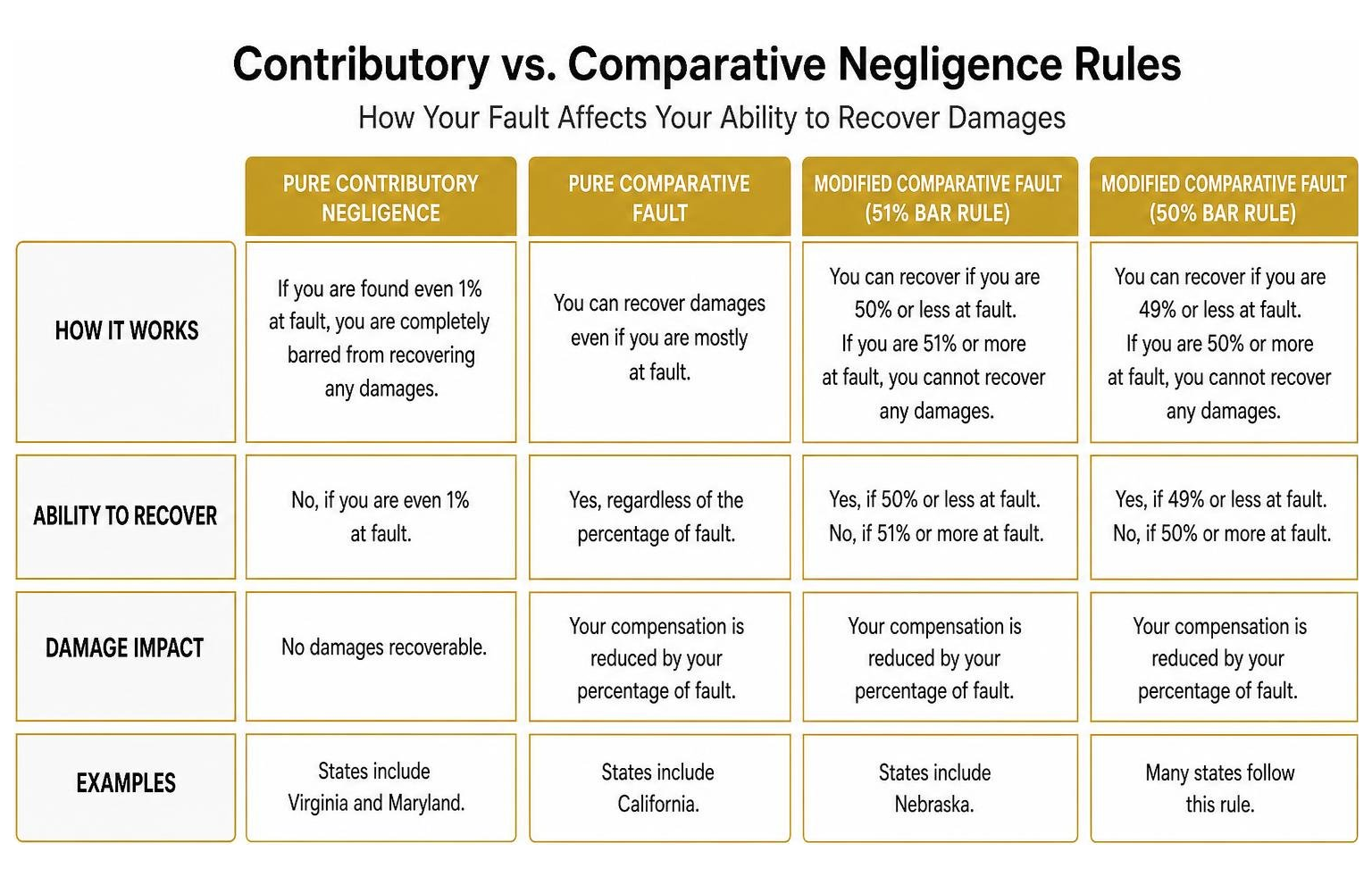
Contributory vs. Comparative Negligence Rules
How your own fault in an accident impacts your ability to recover damages depends heavily on your state’s negligence rules.
- Pure Contributory Negligence: A few states, including Virginia and Maryland, follow this strict rule. If you are found even 1% at fault for the accident, you are completely barred from recovering any damages. This rule makes legal representation absolutely essential, as even minor perceived fault can end a claim. The ‘last clear chance’ doctrine can sometimes provide an exception, but it’s complex.
- Pure Comparative Fault: States like California adhere to this rule. You can recover damages even if you are mostly at fault, but your compensation will be reduced by your percentage of fault. For example, if you are 30% at fault for a $100,000 injury, you can still recover $70,000.
- Modified Comparative Fault: Most states follow a modified comparative fault rule, which has a threshold for recovery.
- 51% Bar Rule: In states like Nebraska, if you are 51% or more at fault, you cannot recover any damages. If you are 50% or less at fault, your recovery is reduced by your percentage of fault.
- 50% Bar Rule: In other modified comparative fault states, if you are 50% or more at fault, you cannot recover. If you are 49% or less at fault, your recovery is reduced proportionally.
Understanding these distinctions is vital. For example, in Nebraska, you can still recover even if partially at fault, but your compensation will be reduced proportionally.
Here’s a simplified comparison of these systems:
Statutes of Limitations and Accrual Dates
A statute of limitations is a law that sets the maximum time after an event within which legal proceedings may be initiated. Missing this deadline, known as the filing deadline, almost always means losing your right to pursue a claim, regardless of its merit.
- State-Specific Deadlines: These deadlines vary significantly by state and even by the type of claim.
- In Virginia, the statute of limitations for most personal injury claims is two years from the date of injury. For wrongful death claims, it’s two years from the date of death.
- Maryland’s statute of limitations for most tort cases is three years from the date the harm accrues.
- In California, most personal injury claims have a two-year statute of limitations from the date of injury, but claims against a government entity often have a much shorter six-month deadline.
- Nebraska generally allows four years from the date of injury for personal injury claims.
- Illinois also typically has a two-year statute of limitations for most personal injury claims.
- Accrual Date: This is the date when the “clock” for the statute of limitations begins. It’s usually the date of the injury, but in some cases (e.g., latent injuries or medical malpractice), it might be the date the injury was discovered or reasonably should have been discovered (the “discovery rule”).
- Tolling Provisions: In specific circumstances, the statute of limitations can be “tolled” or paused. This might happen if the injured party is a minor, mentally incapacitated, or if the defendant left the state.
- Government Entity Notice: Claims against governmental entities often have unique and much shorter notice requirements in addition to the statute of limitations.
Given the strictness and variations of these deadlines, it is crucial to act quickly. Consulting a qualified Pennsylvania personal injury attorney or a lawyer in your specific jurisdiction immediately after an accident is the best way to ensure your claim is filed within the appropriate legal timeframe.
How to Choose the Right Legal Advocate for Your Case
Selecting the right personal injury attorney is one of the most critical decisions you’ll make after an accident. The right advocate can significantly impact the outcome of your case and your ability to secure fair compensation.
Consider the following factors when making your choice:
- Practice Focus and Experience: Look for an attorney who specializes in personal injury law and has extensive experience with cases similar to yours (e.g., car accidents, slip and falls, wrongful death). Some firms, like those with over 60 years of combined experience and having served over 20,000 clients, demonstrate a long-standing commitment to the field.
- Trial Experience and Courtroom Readiness: While most cases settle, choosing an attorney who is prepared and willing to go to trial strengthens your negotiation position. Insurance companies are more likely to offer fair settlements when they know they face a formidable opponent in court.
- Case Results and Track Record: While past results don’t guarantee future outcomes, a firm’s history of successful settlements and verdicts can indicate their effectiveness. Some firms proudly highlight recovering millions of dollars for clients, including 8-figure settlements.
- Communication Transparency: Your attorney should be accessible, responsive, and able to explain complex legal concepts in an understandable way. Clear communication about case progress, potential challenges, and next steps is essential.
- Resource Availability: Complex cases often require significant financial investment for expert witnesses, investigations, and court costs. Ensure your attorney has the resources to fully prepare and pursue your claim.
- Client Testimonials and Reputation: Reviews and testimonials from previous clients can offer insights into an attorney’s professionalism, compassion, and effectiveness.
- Fee Transparency: A clear understanding of the contingency fee agreement and any potential out-of-pocket expenses is crucial.
- Initial Consultation: Most personal injury attorneys offer a free, no-obligation consultation. Use this opportunity to ask questions, assess their approach, and determine if they are the right fit for you.
You are hiring a legal partner for one of the most challenging times in your life. Choose someone you trust, who understands your needs, and who has the expertise to fight for the compensation you deserve.
Frequently Asked Questions About Personal Injury Claims
We understand that you likely have many questions during this difficult time. Here are answers to some of the most common inquiries regarding personal injury claims:
How long does the average personal injury claim take to resolve?
The duration of a personal injury claim varies significantly based on its complexity, the severity of injuries, the willingness of parties to negotiate, and court backlogs. Simple cases with clear liability and minor injuries might settle relatively quickly. For example, many claims resolve within 6 to 18 months through negotiation. However, complex litigation involving severe injuries, multiple parties, or disputed liability can take two to three years or longer, especially if it proceeds to trial. The timeline is also influenced by the victim’s medical recovery; often, a claim cannot be fully valued until the full extent of injuries and prognosis is known.
Can I still recover damages if I was partially at fault for the incident?
This depends entirely on the negligence laws of the state where the accident occurred. As discussed earlier, states like Virginia follow a strict contributory negligence rule, meaning if you are found even 1% at fault, you cannot recover any damages. In contrast, states like California use pure comparative negligence, allowing you to recover damages reduced by your percentage of fault. Most states use a modified comparative negligence rule, where you can recover if your fault is below a certain threshold (e.g., 50% or 51%), with your compensation reduced proportionally. If you believe you were partially at fault, it is crucial to consult an attorney to understand how your state’s laws apply to your specific situation.
What happens if an initial insurance settlement offer is rejected?
It’s common for initial settlement offers from insurance companies to be low, as they aim to minimize payouts. If you reject an initial offer (which an attorney will often advise if it’s unfair), several things can happen:
- Counteroffers and Formal Negotiations: Your attorney will submit a counteroffer, backed by evidence and legal arguments, to the insurance company. This can lead to a series of negotiations.
- Litigation Filing: If negotiations fail to yield a fair settlement, your attorney may recommend filing a lawsuit to initiate formal legal proceedings. This signals to the insurance company that you are serious about pursuing your claim.
- Discovery: Once a lawsuit is filed, both sides enter the discovery phase, exchanging information, documents, and taking depositions. This process can uncover additional evidence that strengthens your case.
- Alternative Dispute Resolution: Before or during litigation, parties may engage in mediation or arbitration to try and resolve the dispute outside of a courtroom.
- Trial: If all other avenues fail, the case will proceed to trial, where a judge or jury will hear the evidence and render a verdict.
Rejecting an initial offer is often a strategic move to ensure you receive the full and fair compensation you deserve, but it requires experienced legal guidance.
Conclusion
Navigating the aftermath of a personal injury is a challenging journey, but you don’t have to face it alone. Understanding the fundamental principles of personal injury law, from tort liability to the nuances of fault determination and statutory deadlines, empowers you to protect your legal rights.
The strategic role of personal injury legal representation cannot be overstated. From handling complex insurer tactics to expertly negotiating settlements and, if necessary, representing you in court, a dedicated attorney acts as your steadfast advocate. Their expertise ensures that your claim is properly valued, critical evidence is preserved, and your rights are upheld every step of the way.
Timely action, meticulous evidence preservation, and informed advocacy are the cornerstones of securing maximum recovery and fair compensation. By choosing the right legal partner, you can focus on your recovery while confident that your legal protections are in capable hands.