Evidence to Preserve After a Disputed Texas Motorcycle Crash
Preserve witness statements, crash photos, and medical records to challenge bias against motorcyclists and document fault after a Texas motorcycle accident.
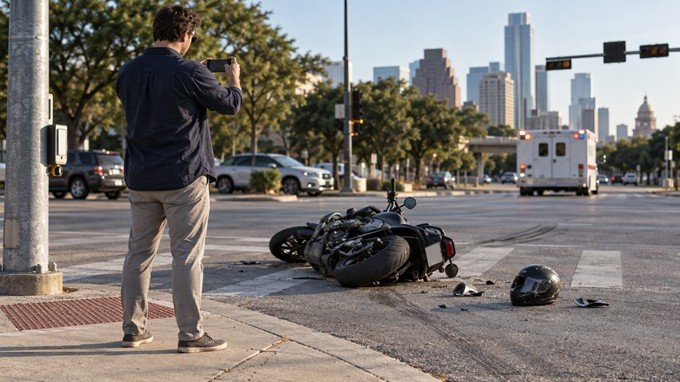
The first account of a disputed Texas crash can reflect bias against motorcyclists. Use witness details to support your account, alongside photographs and records made at the time of the crash.
For Texas during 2023, nearly 600 motorcyclists died and more than 2,400 suffered serious injuries, the Texas Department of Transportation reported in May 2024. With rider deaths up 7%, fatal intersection crashes increased 21%. First comes medical care. For your earliest record, look to an ambulance report or the first photograph you or someone else can safely take.
Neutral records can counter bias against motorcyclists
Step 1: Get emergency care and identify immediate records
For your symptoms, call 911 and accept a medical evaluation. Don’t delay treatment to document the scene; leave traffic only when it’s medically safe. A passenger or trusted person can take notes if you can’t take photographs or notes yourself, without getting in the responders’ way.
For timing, check dispatch logs and ambulance records, then look to emergency room notes and discharge instructions for symptoms you reported. Don’t misstate those symptoms. In your medical history, don’t exaggerate symptoms or ask anyone to include legal wording.
Step 2: Photograph the scene before conditions change
Start with wide photographs showing the intersection and its traffic controls. Before conditions change or damaged vehicles leave their final positions, capture lane markings and sight lines, with weather and lighting included.
Next, photograph vehicle damage up close; capture debris, fluid trails and tire marks, plus pavement gouges. Keep any available time and location metadata with the original files. Leave files unfiltered; don’t crop your only copy. To photograph debris beside a lane stripe, never enter or return to a live traffic lane.
Step 3: Preserve witnesses and early statements
Collect direct contact information, with each witness’s name included. Note where each person witnessed the collision from, whether standing or driving. Separate your interpretation of what happened from the exact words each witness used.
Without adopting or disputing them, record the statements people make early. When legal bias against riders influences the first account of fault, neutral records can matter. Instead of arguing at the scene, preserve another driver’s words if they blame you. Alongside screenshots, save the original texts and voicemails, then write down your recollections of conversations with a date attached.


Preserve physical evidence and official records
Step 4: Protect the motorcycle and riding gear
To preserve any impact marks or transferred material, protect your motorcycle and damaged equipment. Fault isn’t established by one mark. Before anyone cleans, repairs, discards or destructively tests an item, photograph it, including its abrasion patterns. Label bags of detached parts with each part’s original location as you store them.
Until documentation is complete and any necessary inspection is coordinated, don’t authorize repairs or surrender original gear. A cracked visor belongs with its helmet.
Step 5: Request records before video disappears
Through TxDOT’s official process, request your crash report. For available 911 audio and photographs, ask the responding agency, then ask how to request body camera footage or supplemental reports.
Video isn’t permanent. Look for nearby traffic cameras and doorbell cameras; identify any businesses with footage, too. For parked vehicles, ask about dashcams. Because storage practices vary, promptly send a written preservation request that identifies the date and approximate time, plus the location and footage to preserve.
Troubleshoot the most common disputed crash accounts
Fault isn’t settled by one item. With these prompts, match disputed accounts to relevant evidence, such as intersection footage.
| Disputed account | Evidence to preserve | What not to assume
|
| Left-turn collision | Signal phase; sight lines; vehicle positions; approach paths; intersection video; witness location | Do not infer speed solely from injury severity or the distance the motorcycle moved. |
| Unsafe lane change | Damage contact points; lane markings; mirror position; turn-signal observations; dashcam footage | Do not convert “I did not see the motorcycle” into an admission the speaker did not make. |
| Road hazard | Safe wide and close photographs; exact location; hazard dimensions; warning signs; repair activity | Do not enter traffic or disturb the condition to stage a clearer photograph. |
| Claim that the rider traveled between lanes | Video; witness accounts; GPS data; lane position; traffic movement; point of impact | Texas Transportation Code Section 545.0605 prohibits specified motorcycle operation between same-direction traffic lanes. Preserve the facts rather than accepting another driver’s label. |
Build a timeline without making an admission
Connect medical and income records with communications
Gather scene records and witness contacts, plus medical documents and available official reports, before speaking with an insurer. In one dated chronology, use separate columns for time, event, source and unresolved question.
Only supported facts belong here. Mark an uncertain time as an estimate, rather than filling in the gap yourself. Alongside repair communications, track treatment dates and work absences, then log insurer contacts and evidence requests. Don’t discard originals. By date, organize bills and wage records; share copies when appropriate.
You’re describing an observation with “The car moved left across the lane”. An unproven motive is assigned by “The driver deliberately cut me off”. Give each entry a source, such as a discharge record dated the night of the collision.

A record that stays grounded in facts
In your crash file, record changing conditions; keep observations apart from assumptions. Rather than fill in unknowns, mark them and connect each timeline entry to a record or witness. Ahead of documentation come medical care and personal safety. To give a careful account of what happened, you don’t have to settle fault at the roadside.
Sources
- Texas Department of Transportation: Motorcyclist deaths on the rise in Texas.
- Texas Department of Transportation: Crash reports and records.
- Texas Legislature: Transportation Code, Section 545.0605.