Securing Your Future: Child Custody and Legal Support
Suffolk County relocation lawyer guidance: Learn legal steps, risks, and key factors for child custody moves. Secure your parental rights today.

Legal Framework for Parental Relocation in Suffolk County
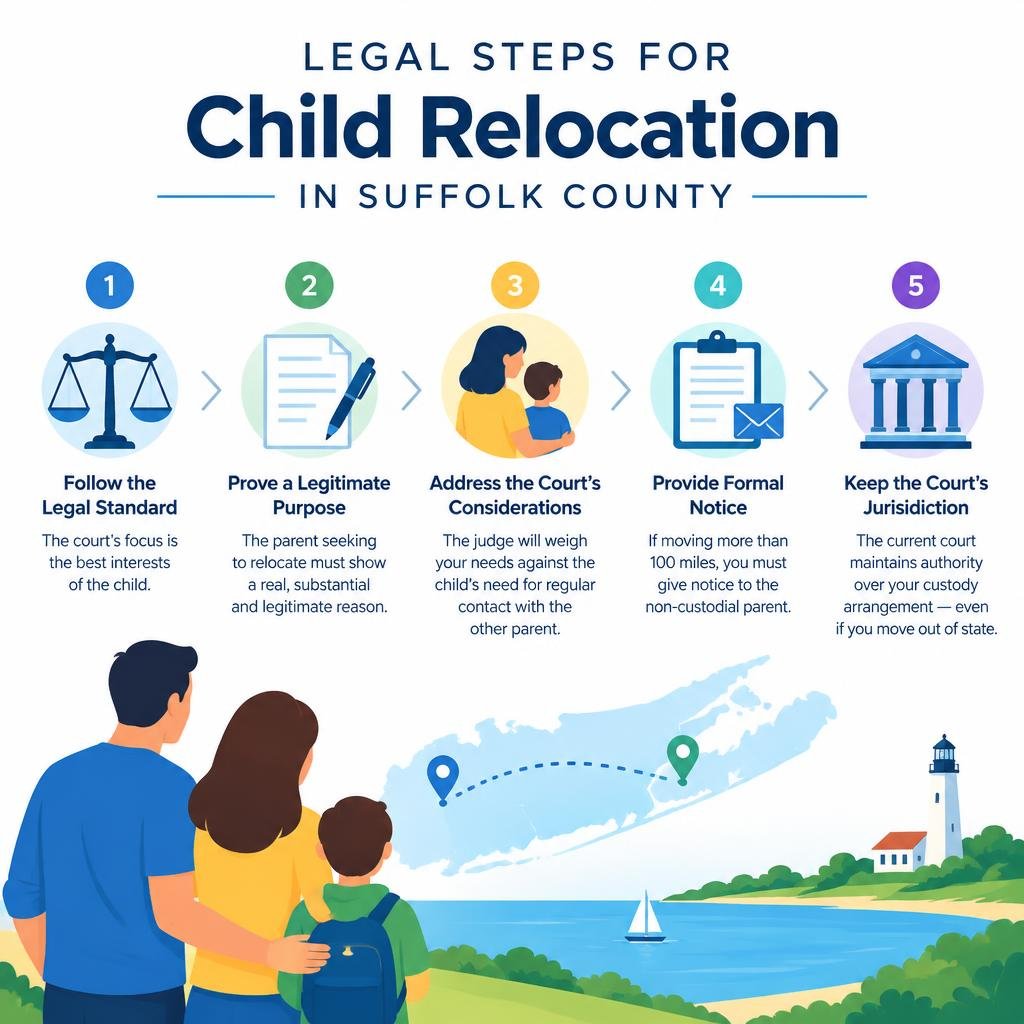
In Suffolk County, the governing principle for any relocation dispute is the “best interests of the child.” This standard is not a vague concept but a rigorous judicial inquiry shaped by the landmark New York Court of Appeals case, Tropea v. Tropea. Under this precedent, the parent seeking to relocate bears the burden of proving that the move serves a “real, substantial, and legitimate” purpose.
When you petition the Suffolk County Family Court, you are essentially asking a judge to weigh your personal or professional needs against the child’s need for regular, meaningful contact with the other parent. Because Suffolk County handles over 10,000 custody and visitation petitions annually, the court system is highly experienced in identifying when a move is truly beneficial versus when it is intended to hinder the other parent’s access.
Legal Requirements for Interstate and In-State Relocation
While New York law does not set a hard mileage limit for relocation, judicial scrutiny intensifies significantly when a parent plans to move more than 100 miles away. Statistics indicate that over 65% of relocation cases in Suffolk County involve moves of this distance or greater.
If you are planning such a move, you must provide formal notice to the non-custodial parent. Simply moving without a court order or a signed, notarized agreement is a dangerous gamble. Jurisdictional rules dictate that the court currently overseeing your custody arrangement maintains authority over the child, and you cannot unilaterally strip that court of its power by moving across state lines. Under the Uniform Child Custody Jurisdiction and Enforcement Act (UCCJEA), New York retains exclusive, continuing jurisdiction over custody matters as long as the child or at least one parent continues to reside in the state and significant connections remain.
In practical terms, this means that even if a parent attempts to establish residency in another jurisdiction, the Suffolk County Family Court or Supreme Court still holds the authority to issue binding custody determinations, order the return of the child, and penalize non-compliance. Parents must understand that filing a formal petition for modification of custody or permission to relocate before any physical relocation occurs is an absolute legal necessity.
Risks of Relocating Without Court Authorization
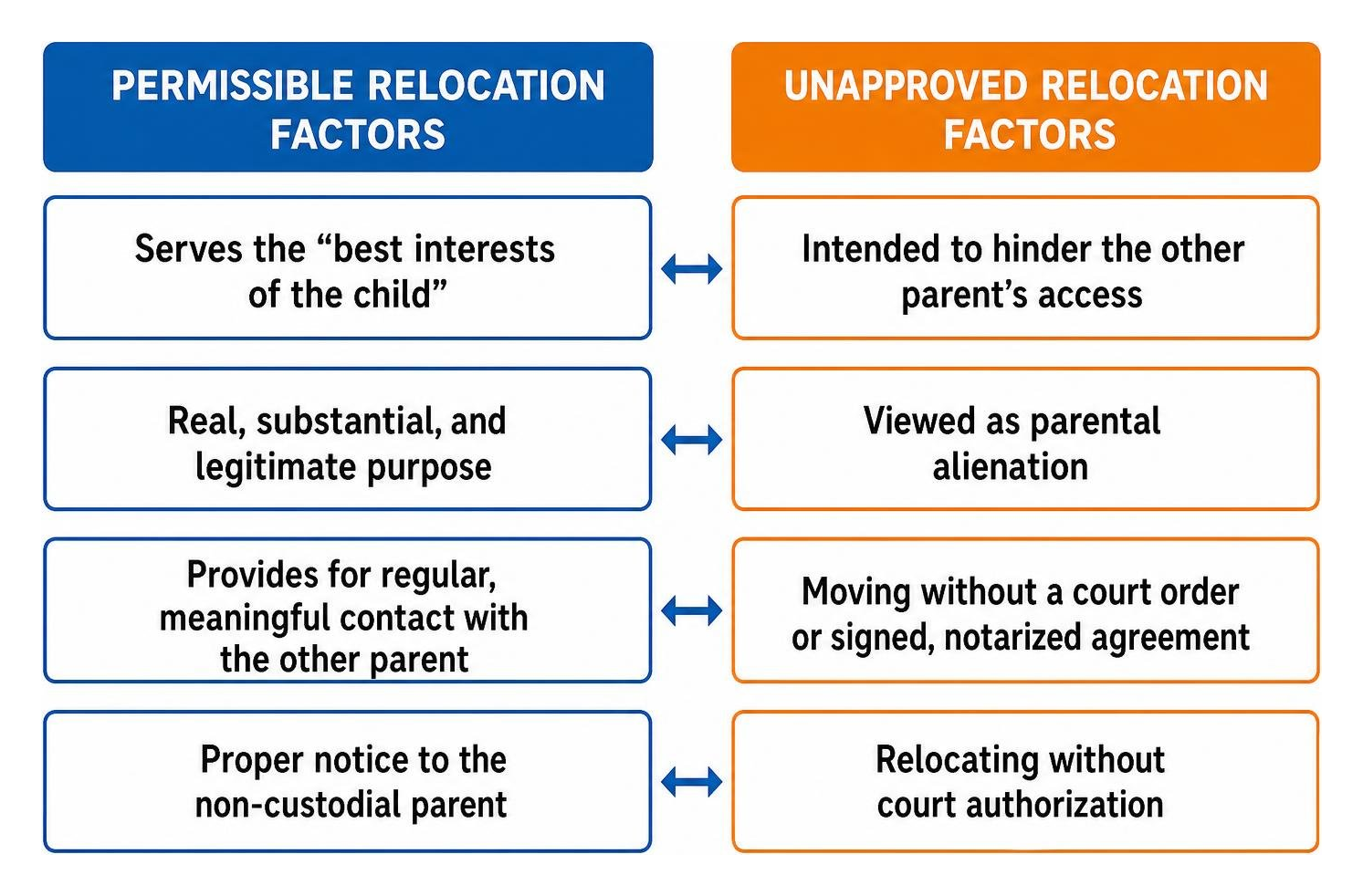
Moving a child without prior approval is often viewed by the court as a form of parental alienation. If you relocate without a court order, the non-custodial parent can file for an emergency order, which may result in a judge mandating the immediate return of the child to Suffolk County. Furthermore, you risk facing contempt petitions, which can lead to fines, loss of residential custody, or even the court awarding the other parent primary custody as a corrective measure.
Judges view unilateral relocation as a direct violation of the co-parenting relationship and an affront to the authority of the court. When a parent removes a child without permission, it creates an immediate presumption that the parent is unwilling to foster an ongoing, healthy relationship between the child and the non-relocating parent. The court may issue a writ of habeas corpus or an ex parte order directing law enforcement to assist in retrieving the child. In addition to losing physical custody, the violating parent may be ordered to pay the other party’s attorney fees and travel expenses incurred while recovering the child.


The Role of Child Custody Legal Support in Complex Moves
Navigating a relocation petition involves more than just filing paperwork; it requires a strategic approach to evidentiary hearings and settlement negotiations. Because the average cost of a contested relocation case can range from $15,000 to $50,000, many families look for transparent, predictable billing structures. Utilizing flat-fee family law services can ensure your case is presented with the necessary documentation to justify the move without unexpected legal expenses piling up during an already stressful period.
Securing Child Custody Legal Support for Relocation Petitions
When filing your petition, your legal team must help you build a “relocation package.” This includes evidence of economic enhancement (such as a new job offer), improved educational opportunities for the child, and a robust support system in the new location. A lawyer helps you draft a comprehensive relocation plan that addresses how you intend to maintain the child’s bond with the other parent, which is often the deciding factor in whether a judge grants your request.
A complete relocation package goes beyond generalized claims. It provides detailed documentation, such as official employment offer letters detailing salary increases, health benefits, and flexible work schedules that allow more quality time with the child. It includes comparative school district performance reports, highlighting specialized academic tracks, extracurricular programs, or special education resources that directly address the child’s individual needs. Furthermore, the petition should detail specific housing arrangements, demonstrating a safe, stable neighborhood with access to recreational and community facilities.

Responding to Objections with Child Custody Legal Support
If you are the parent opposing a move, you have the right to challenge the petition. A relocation lawyer can help you negotiate a revised parenting plan that might include expanded summer visitation, virtual contact, or a reallocation of travel costs. By focusing on the preservation of the parent-child relationship, you can effectively demonstrate to the court why the proposed move is not in the child’s best interest.
When formulating an objection, non-custodial parents must present clear evidence of their active, ongoing involvement in the child’s daily life. This includes proof of regular attendance at parent-teacher conferences, involvement in extracurricular coaching or transportation, medical appointments, and consistent weekday and weekend parenting time. Demonstrating that the physical distance would fundamentally erode an established, deep emotional bond is central to defeating an unreasonable relocation petition. Legal counsel can assist in demonstrating alternative solutions that maintain stability for the child while addressing any legitimate concerns raised by the petitioning parent.
Key Factors Influencing Judicial Relocation Determinations
Courts in Suffolk County are tasked with a delicate balancing act. They look at the quality of life the child will experience in the new location compared to the stability they currently enjoy. While career advancement is a valid reason to move, it must be balanced against the loss of the child’s established community, school, and relationship with the non-custodial parent. Under New York law, no single factor is dispositive; instead, judges evaluate each case on its unique merits.

Elements That Strengthen a Relocation Request
A request is generally viewed more favorably if it is supported by concrete, verifiable evidence:
- Economic Stability: Proof of a higher salary, lower cost of living, career advancement, or improved health insurance coverage that directly enhances the child’s standard of living.
- Family Support: The presence of grandparents, aunts, uncles, or close extended family in the new location who can provide daily child care, emotional support, and a broader family network.
- Educational Continuity: Evidence that the prospective school district offers academic excellence, individualized education programs (IEPs), advanced placement coursework, or extracurricular opportunities superior to or matching the current school.
- Realistic Long-Distance Parenting Plan: A proactive proposal that offers the non-relocating parent generous blocks of parenting time during summer vacations, school breaks, and holidays, alongside a clear, equitable plan for funding transportation costs.
Circumstances That Weaken a Relocation Request
Conversely, the court will likely deny a request if there is evidence of:
- Vindictive Motivation: Any indication that the move is designed to interfere with, diminish, or sever the non-custodial parent’s access and relationship with the child.
- Disrupted Visitation: A failure to provide a realistic, workable plan for how the child will maintain regular and meaningful contact with the other parent.
- Speculative Benefits: A move based on vague promises of a “better life,” uncertain romantic relationships, or unconfirmed employment opportunities without binding offers or concrete proof of improved circumstances.
- Severing of Essential Ties: Situations where the child has profound community roots, specialized medical providers, or established therapeutic relationships in Suffolk County that cannot be easily replicated in the proposed destination.
Frequently Asked Questions About Child Relocation
How does the court define the child’s best interest in relocation disputes?
The court looks at the “totality of the circumstances.” This includes the child’s emotional development, their bond with each parent, the stability of the current home environment, and the potential impact of the move on the child’s educational and social life. The judge also considers the quality of the relationship between the parents, each parent’s ability to cooperate, and the feasibility of preserving the non-custodial parent’s relationship through meaningful alternative parenting schedules.
What happens if a parent moves the child without prior court consent?
As noted, this can trigger immediate legal repercussions. The court may issue an emergency order requiring the child’s return. Additionally, such actions often damage a parent’s credibility, making it significantly harder to win future custody battles. The parent who removed the child may face contempt charges, monetary sanctions, and a permanent change in residential custody in favor of the non-relocating parent.
Can a non-custodial parent prevent an out-of-state move?
Yes. By filing a formal objection and seeking a court injunction, a non-custodial parent can force a hearing. The court will then evaluate whether the move would cause undue harm to the child’s relationship with the non-custodial parent. Because New York courts deny approximately 40% of relocation requests when the move would substantially disrupt the non-custodial parent’s access, the likelihood of a successful objection is statistically significant if the move is poorly planned or fails to serve the child’s overall wellbeing.
How does the distance of the proposed move affect the court’s decision?
While there is no rigid statutory mileage limit in New York, the practical impact of the distance on the existing parenting schedule is a primary judicial consideration. A move of 30 miles within Long Island that lengthens a school commute may be scrutinized if it disrupts weekday visitation, whereas an out-of-state move of 500 miles inherently eliminates mid-week dinners and weekend alternating schedules. The farther the distance, the greater the burden on the moving parent to demonstrate substantial, compensatory benefits for the child.
Who pays for the travel expenses associated with long-distance visitation?
Travel expenses are allocated based on the financial circumstances of each parent and the reasons behind the relocation. Often, the court will require the relocating parent to bear a substantial portion, if not the entirety, of the travel costs, including flights, train fares, or gas mileage. In some cases, the court may offset these expenses by adjusting child support obligations or ordering the relocating parent to provide all necessary transportation arrangements.
Conclusion
Relocation is a life-altering event that requires careful, strategic planning. Whether you are the parent seeking to move or the parent fighting to keep your child nearby, the process demands a deep understanding of Suffolk County’s legal standards. By prioritizing the child’s best interests, maintaining transparency, and securing the right legal support, you can work toward a resolution that protects your family’s future. The court’s goal is not to punish or reward parents, but to ensure that the child’s growth and relationships remain as stable as possible during a period of transition.